Spotlight
Spotlight Odonchimeg Davaadorj Draws From a Living World
Championed by Dilda Ramazan

Above A Poem From the Volcano, AKINCI, 2026. Photo: Peter Tijhuis
ONES TO
WATCH
WATCH
ONES TO
WATCH
WATCH
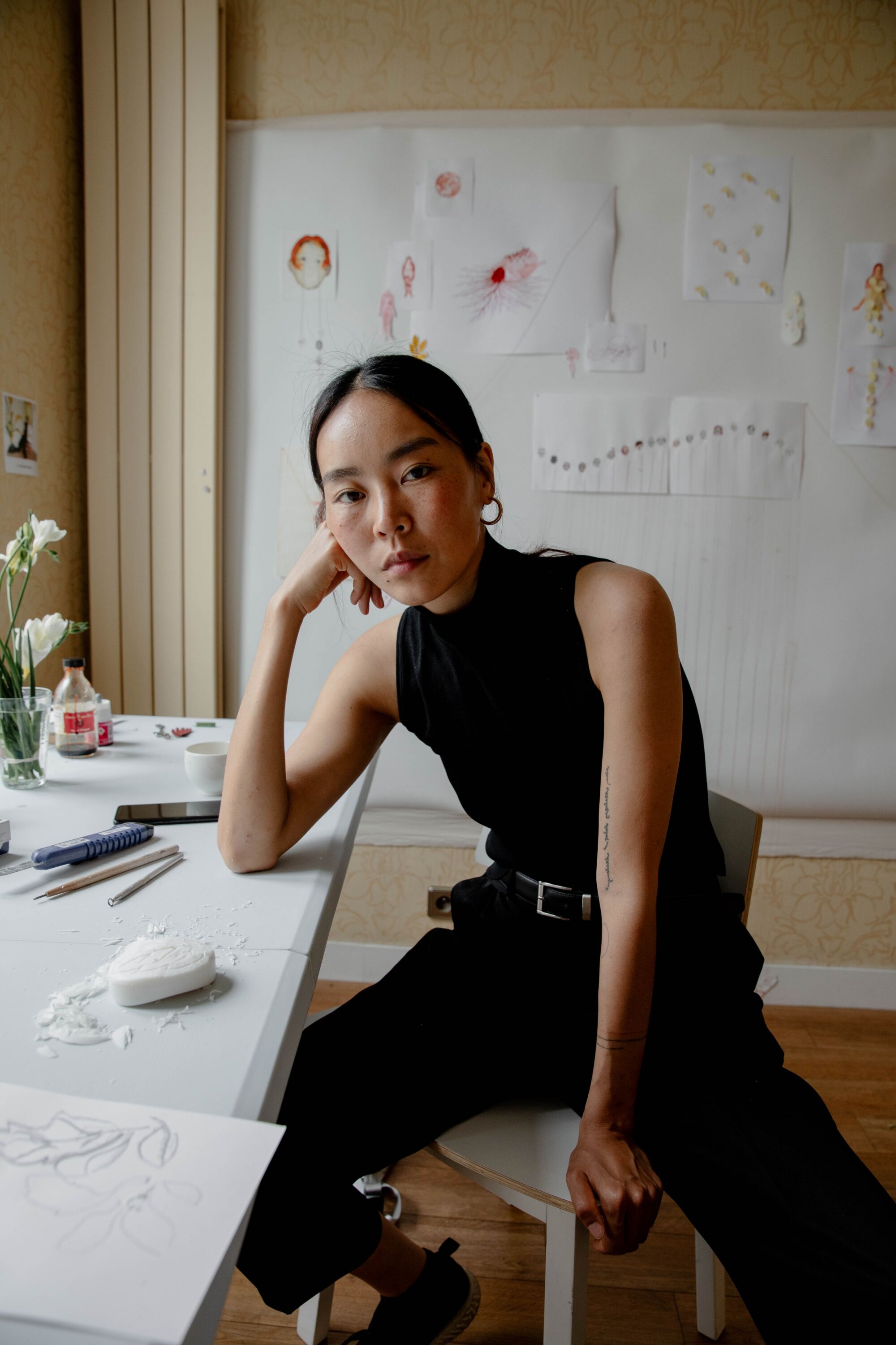
Above Photo: Chantapitch Wiwatchaikamon
Interview
Odonchimeg Davaadorj
Photography
Chantapitch Wiwatchaikamon
Interview
Odonchimeg Davaadorj
Photography
Chantapitch Wiwatchaikamon
Odonchimeg Davaadorj does not always know what a drawing will become when she begins it. As Asian Art in London prepares to return for its 29th edition, The Wick turns its Spotlight to the Mongolian-born artist, whose practice spans drawing, painting, sculpture and installation, alongside video, performance, dance, poetry and clothing.
“Sometimes, I begin with research into a particular subject or a form that draws my attention,” Davaadorj tells The Wick. “But more often, my process starts from somewhere less defined, from an intuition, an image, or a feeling that I can’t always explain. Drawing becomes a kind of inner journey, where I follow these impulses and allow them to transform into forms, figures, and unexpected connections.”
Born in Darkhan, Mongolia, Davaadorj left the country at 17, travelling first to the Czech Republic and later to France. She went on to study at the École nationale supérieure d’arts de Paris-Cergy, completing her Bachelor in 2014 and Master in 2016. Before leaving Mongolia, an almost self-sufficient life in a remote village gave her a particularly close relationship with nature, which remains one of the strongest influences on her work. Across different forms, the artist’s work repeatedly returns to living things. Human figures appear alongside animals and plant life, with bodies and landscapes sometimes becoming difficult to separate.
Davaadorj’s Champion is Dilda Ramazan, a curator, art critic and researcher whose work focuses in part on contemporary art in Central Asia. Ramazan is particularly drawn to the way Davaadorj places different forms of life alongside one another without establishing an obvious order between them.
“Odonchimeg Davaadorj is an artist whose poetic visual language immediately carries the viewer into a world where living beings coexist without hierarchy. Through a vivid palette and a light yet precise gesture, she tells stories of birds and children, of belonging and uprooting, of silence and distant soundscapes.
Her practice spans drawing, watercolour, sculpture, and installation; each medium is treated with tenderness and assurance, while the boundaries between them often dissolve into a multidisciplinary whole.”
“Odonchimeg Davaadorj is an artist whose poetic visual language immediately carries the viewer into a world where living beings coexist without hierarchy.”
Odonchimeg Davaadorj
Ramazan also points to the relationship between Davaadorj’s materials and the natural world.
“The materials Davaadorj works with are organic, drawn from the earth and returning to its cycles of growth, decay, and transformation. Her practice therefore appears less as an artificial construction than as an extension of the environment itself.
Encountering her works feels like recalling an almost forgotten dream that suddenly resurfaces after a striking visual encounter. Davaadorj’s art possesses a soothing quality, inviting the viewer into a state of calm, attentive observation.”
Davaadorj measures achievement through the development of the practice itself. She describes gradually becoming the artist she had hoped to be, while continuing to make work capable of surprising her. The acquisition of her work by the Centre Pompidou in Paris has been an important milestone, but she places equal importance on maintaining the freedom to keep discovering something new. “For me,” she says, “the real achievement is being able to keep growing, discovering, and creating with honesty and freedom.”
The artist’s next body of work continues this enquiry through oil painting, drawing and installation. Davaadorj is exploring the relationships between humans, animals and nature within what she describes as a “larger living world”. She is also preparing large-scale drawings and paintings in which bodies, landscapes and imagined beings can merge into one another. A solo exhibition, ‘Too light to hold’, is also planned at Gallery Car.D in Bologna, Italy.
Davaadorj’s advice to another artist returns to the instinct that begins so much of her own work: “Stay curious, trust your intuition, and don’t be afraid to follow what you don’t yet understand.”
About the champion

Dilda Ramazan is a curator, art critic, and researcher. She is the laureate of the 2026 Elisabeth Couturier Art Criticism Prize. Member of DAVRA, she is currently pursuing a PhD at Sorbonne University, examining contemporary art scenes in Kazakhstan, Kyrgyzstan, and Uzbekistan after 1991.
Above A Poem From the Volcano, AKINCI, 2026. Photo: Peter Tijhuis

Above A Poem From the Volcano, 2026

Above Blue eye doesn’t cry, 2025

Above

Above

Above After midnight love is free 1, 2025
Above A Poem From the Volcano, AKINCI, 2026. Photo: Peter Tijhuis
Above A Poem From the Volcano, 2026
Above Blue eye doesn’t cry, 2025
Above After midnight love is free 1, 2025