Dream & Discover
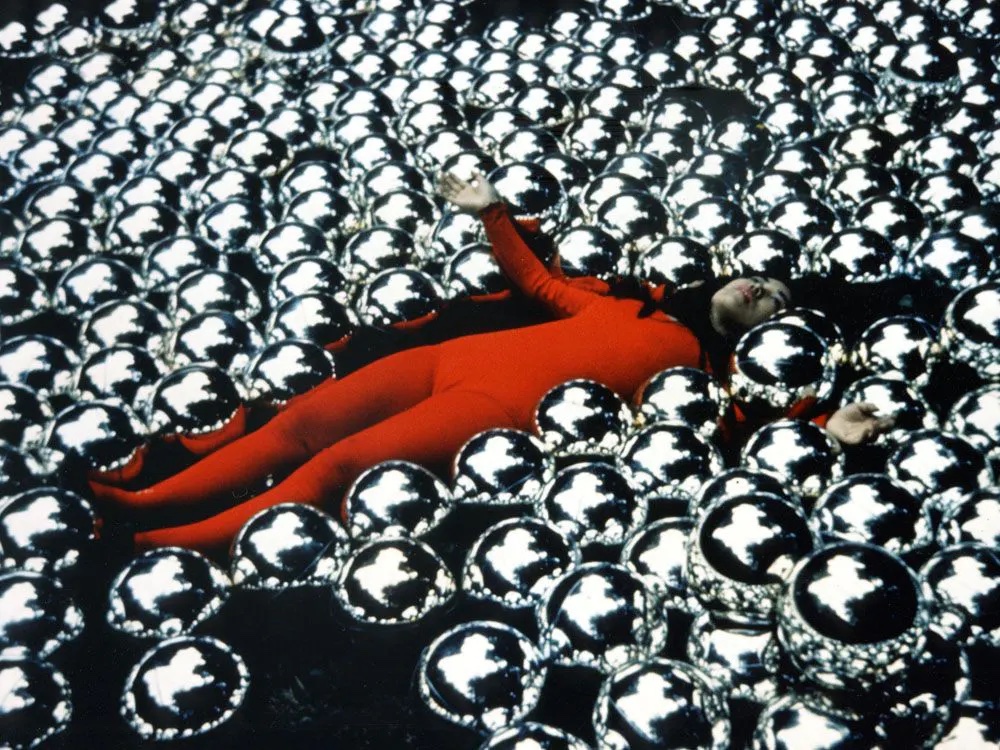
Discover Narcissus Garden, 1966, by Yayoi Kusama
1966, by Yayoi Kusama
Reflecting on the most controversial and memorable works of sixty Venice Biennales, one work stands out: Yayoi Kusama’s Narcissus Garden. In 1966, Kusama installed 1500 plastic reflective spheres – a “kinetic carpet”, as the artist referred to it – on the grass outside the Italian Pavilion during the 33rd Venice Biennale. Kusama had not been invited to participate in the Biennale – but she showed up in a gold kimono fastened with a silver obi, and handed out printed praise for her work, attempting to sell her scintillating balls at 1200 lire a piece (equivalent to about 50p in today’s currency, the buy of the century for those who purchased).
In 1966, Kusama wasn’t very well known in Europe, though in New York her first mirrored installation, Infinity Mirror Room – Phalli’s Field (1965) had attracted a lot of attention in the US. According to Kusama, Lucio Fontana supported Narcissus Garden, and they had secured permission from the Chairman of the Biennale – but the installation caused an uproar nonetheless. Kusama said: “They made me stop, telling me it was inappropriate to sell my artworks as if they were ‘hot dogs or ice cream cones’. But the installation remained.”
A comment on the commercialisation of art, Narcissus Garden had all the hallmarks of Kusama’s now world-famous works: hallucinatory, expansive installations that immerse the viewer and invite self-reflection and even self-obliteration. In the years that followed, Kusama continued to restage Narcissus Garden all over the world in different ways. Thirty years later it all came full circle when, in 1993, Kusama was selected to represent Japan at the Venice Biennale – becoming both the first individual artist and the first woman to represent her country. But it’s Narcissus Garden – one of the works that kickstarted Kusama’s international career – that remains one of the icon moments in the history of the Biennale.