Dream & Discover
Work of the Week

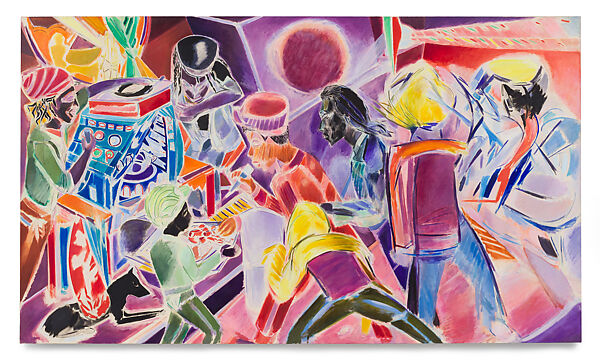
The Wick Culture - Denzil Forrester, Dub, 1985

Dream Dub by Denzil Forrester

Dub,
1985, Denzil Forrester

On International Jazz Day, we are taking a closer look at Denzil Forrester’s Dub, a 1985 painting that captures music as something felt collectively as much as heard. Shaped by Forrester’s experience of London dub culture in the 1980s, the work draws on the all-night sessions he attended and sketched. Bodies blur across a compressed, vibrant interior, while the DJ and speaker stack anchor the scene at its edge. Rather than simply depicting a single venue, Forrester paints the sensation of being inside it: the heat, the rhythm, the press of the crowd, the energy flowing between people in the room. This sense of exchange gives Dub a connection to jazz as well, through the two genres’ shared emphasis on playfulness, spontaneity and community. The painting also stands as an important record of Black British social life in the 1980s, preserving a culture of joy, creativity and collective gathering too often overlooked in art history.

Visit website

The Wick Culture - Peter Doig, Alpinist, 2023

Dream Alpinist by Peter Doig

In celebration of Peter Doig’s 67th birthday week, we are taking a closer look at Alpinist, a 2023 work that brings together many of the qualities that have made the artist one of the most distinctive painters of his generation. The painting turns the language of the ski poster into something stranger, depicting a lone skier in harlequin checks edging across an icy ledge, red skis strapped in a cross on his back, while the Matterhorn rises over a deep white valley behind him. But despite being shaped by the imagery that informed Doig’s time in Zermatt, the scene is far from a straightforward Alpine idyll. The mountain is split between sunlight and shadow, the figure is vivid but solitary, and the whole composition carries the subtle tension that gives so much of Doig’s work its charge. Made after a painting created between 2019 and 2022, Alpinist reflects the artist’s ability to transform lived places into images suspended between memory and imagination, turning a winter landscape into something elusive and faintly haunting.
Share
The Wick Culture - © Sarah Lucas

Discover Self-Portrait with Fried Eggs, Sarah Lucas, 1996

There are self-portraits that flatter, and then there are the ones that fight back. Sarah Lucas’s Self-Portrait with Fried Eggs belongs firmly to the second camp. Made in 1996 as part of her wider cycle of 1990s self-portraits, the work shows Lucas sprawled in an armchair in ripped jeans and a T-shirt, meeting the viewer with a stare that is knowing and completely unbothered. The image feels insolent in the best way possible. The fried eggs placed over her chest are, on one level, a visual gag. But beneath the humour and crudeness, the eggs turn the female body into a caricature, pushing the absurdity of sexual cliché until it becomes accusatory. Lucas presents femininity as something performed, projected and consumed, then sabotages the whole mechanism with a single deadpan image. The tension between masculine and feminine codes, parody and self-possession, swagger and vulnerability, runs through Lucas’s work. Born in London and emerging from the Goldsmiths generation in the early 1990s, she built a practice out of tabloid culture, bodily metaphor and the rough poetry of everyday materials. In Self-Portrait with Fried Eggs, all of this condenses into one distinct composition. Even the discarded cigarettes in the corner work to suggest recklessness, while Lucas remains fully in control of the scene. What makes the picture endure is its refusal to resolve neatly. Lucas stages herself inside the very codes she is dismantling, turning the image into both parody and challenge. Nearly three decades on, it still feels as pointed and confrontational as ever.
Share
The Wick Culture - Photographed by Martti Salmi

Dream Academy Award of Merit

Following the 98th Academy Awards ceremony that took place earlier this week, we take a closer look at the history of the Oscar statuette, officially known as the Academy Award of Merit, one of the most famous sculptures in popular culture and an international icon of the film industry. The sculpture was created in 1928 by the American artist George Stanley, based on a design concept by Cedric Gibbons, an art director at Metro-Goldwyn-Mayer. It was designed for the Academy of Motion Picture Arts and Sciences to serve as the trophy for achievements in filmmaking. George Stanley transformed Gibbons’s sketch into a three-dimensional sculpture. The design shows a knight standing upright while holding a crusader’s sword. The knight stands on top of a film reel with five spokes. These spokes represent the five original branches of the Academy: actors, directors, producers, writers, and technicians. Stanley’s sculpture combines classical artistic style with modern symbolism connected to the film industry. The Oscar statuette is about 13.5 inches (34 cm) tall and weighs approximately 8.5 pounds (3.9 kg). Today it is made from bronze and plated with 24-karat gold, giving it its distinctive golden appearance. The smooth surface, balanced posture, and simple but powerful design reflect Stanley’s skill as a sculptor and his ability to create a timeless symbol. The first Oscar awards ceremony took place in 1929, and since then the statuette has become one of the most recognisable awards in the world. Each year, winners receive this sculpture as a sign of excellence in cinema. George Stanley’s work has therefore become a lasting icon of achievement in the global film industry and a symbol of artistic and creative success.
Share
The Wick Culture - Frank Bowling, 2014, Dawning

Dream Dawning by Frank Bowling

In celebration of Frank Bowling’s birthday – the artist turns 92 today – we are taking a closer look at the artist’s 2014 painting, Dawning. It exemplifies the artist’s long-standing exploration of colour, materiality and migration. Created during a later phase of his career, the painting demonstrates Bowling’s commitment to abstraction as a space for memory and sensation rather than direct representation. Dawning is characterised by luminous washes of colour that appear to bleed and pool across the canvas. Bowling often pours, stains and layers acrylic gel and pigment, allowing gravity and chance to shape the surface. In this work, light seems to emerge from within the painting itself: warm tones diffuse into cooler hues, evoking the transitional moment suggested by the title—the threshold between night and day. Although abstract, the painting carries subtle geographical and emotional resonances. Throughout his career, Bowling has referenced maps of Guyana and the transatlantic crossings that shaped his own migration from Guyana to Britain and later the United States. In Dawning, the sense of emergence can be read metaphorically, suggesting renewal, displacement or the continual becoming of identity. The textured surface, built up through accumulations of gel and pigment, gives the painting a sculptural presence. Light catches the ridges and drips, reinforcing the idea of time embedded in matter. Dawning thus embodies Bowling’s belief that abstraction can hold personal and political histories, transforming colour into a vessel for memory and change. Dawning will be shown by Marc Selwyn Fine Art, booth D1 at Frieze LA opening from today.
Share
The Wick Culture - The Kiss by Edvard Munch (1897)

Dream The Kiss by Edvard Munch

A Valentine’s special edition: Edvard Munch’s The Kiss is among the most haunting and poignant meditation on love, intimacy, and the loss of self in art history, yet it is a less celebrated work in the Norwegian artist’s oeuvre. Painted in several versions between the 1890s and early 1900s, the work shows a couple locked in an embrace inside a dimly lit room. Their faces merge into a single, indistinct form, blurring the boundary between two individuals. Rather than presenting romantic love as purely tender or joyful, Munch frames it as something intense, consuming, and faintly unsettling. The setting plays a crucial role in shaping this mood. The dark interior contrasts with the faint light from the window behind the couple, isolating them from the outside world. This enclosed space suggests secrecy and withdrawal, as if love requires turning away from society. The heavy shadows and muted color palette heighten the sense of emotional weight, reinforcing the idea that intimacy is both comforting and dangerous. Munch’s treatment of the figures is especially striking. Their bodies are simplified, and their merged faces become almost mask-like, erasing clear identity. This visual fusion can be read as a symbol of emotional unity, but it also hints at a loss of individuality. Love, in Munch’s vision, threatens to dissolve the self, an idea that reflects his broader anxieties about human relationships. The Kiss belongs to Munch’s larger exploration of love, anxiety, and death, themes that recur throughout his work – including in his most famous work, The Scream. Rather than idealizing romance, he exposes its psychological complexity. The painting invites viewers to reflect on intimacy as a powerful force—one that promises connection while simultaneously risking annihilation of the individual.
Share
The Wick Culture - Lubaina Himid, Bitter Battles, 2023.

Dream Bitter Battles by Lubaina Himid

Two seated figures sort lemons at a table in Lubaina Himid’s Bitter Battles (2023), a painting extends her long-standing practice of using painting and installation to stage history as an active, contested space. The work confronts conflict not as spectacle, but as an accumulation of quiet, grinding struggles shaped by empire, trade, and racialized power. Through her characteristic use of bold color, flattened perspective, and carefully choreographed figures, Himid evokes scenes that feel both theatrical and archival, as if memories are performing themselves. The title suggests, with a sly nod to the sour taste of the citrus fruit, confrontation, yet the battles here are often internal, bureaucratic, or domestic, unfolding across tables, ships, and interiors rather than open fields. Himid’s visual language resists heroic resolution: her figures are often poised, paused, or mid-gesture, inviting viewers to consider what has been omitted from official narratives. The beauty of the surfaces and rhythmic repetition of her works offer solace, reminding us that aesthetic pleasure can coexist with historical violence. The work asks who is allowed to speak, who labors unseen, and who bears the cost of progress. In Bitter Battles, Himid reframes history as something unfinished and in constant negotiation. By foregrounding Black presence and agency, she challenges inherited myths and opens space for alternative readings. The result is a reflective, insistent meditation on power, memory, and the persistence of struggle today, urgently, and without compromise. Himid will represent Britain at the Venice Biennale in May, 2026.
Share
The Wick Culture - Sunlight in the blue room by Anna Ancher

Dream Sunlight in the Blue Room by Anna Ancher

Sunlight in the Blue Room (1891) by the Danish painter Anna Ancher is a luminous celebration of light, color, and quiet domestic life—hallmarks of her artistic voice within the Skagen painters’ community. Though many of her contemporaries focused on dramatic seascapes and the rugged lives of fishermen, Ancher turned inward, revealing the spiritual and emotional richness of the everyday interior. In this work, she transforms an ordinary room into a radiant study of sunlight and chromatic harmony. The painting depicts a young woman seated at a table in a modest blue room. The figure is turned away from the viewer, encouraging an intimate yet observational distance. The true protagonist of the scene is not the woman, but the sunlight itself, which streams through a window and floods the room with warm illumination. The golden light interacts dynamically with the cool blue walls, creating a compelling contrast that reveals Ancher’s mastery of color theory. Rather than relying on sharp detail, she uses soft brushstrokes and delicate transitions of tone to suggest texture and atmosphere. The composition’s simplicity heightens its quiet emotional resonance. The space feels contemplative, almost sacred, capturing a moment suspended in time. In the absence of narrative drama, the viewer is invited to reflect on the serenity of solitude and the beauty found in ordinary surroundings. With Sunlight in the Blue Room, Ancher redefines what is worthy of artistic attention, revealing domestic space as a site of profound aesthetic and spiritual experience. Through light, she transforms the everyday into the extraordinary.
Share
The Wick Culture - Spider by Leonora Carrington

Dream Spider by Leonora Carrington

A seasonally spooky artwork: 'Spider' (1967) by Leonora Carrington is a surreal and symbolic work that reflects the late British-Mexican artist’s fascination with mythology, transformation, and the feminine psyche. The spider, a recurring motif in Carrington’s art and writing, represents both creation and entrapment - a paradox central to her vision of womanhood and artistic identity. In this piece, the spider can be seen as a self-portrait of the artist herself: weaving intricate webs that connect dreams, memory, and myth. Carrington, associated with the Surrealist movement, often used fantastical imagery to challenge patriarchal structures and rational thought. The spider’s web becomes a metaphor for storytelling and for the interconnectedness of all living things. Through its delicate yet powerful threads, Carrington suggests that creativity and chaos are inseparable forces. The spider embodies patience, wisdom, and the mystical power of the feminine - a figure that spins her own universe from within. Ultimately, Spider reveals Carrington’s belief in the transformative potential of imagination, where art becomes a web that binds spirit and matter, the real and the magical, into one continuous act of creation.
Share
The Wick Culture - Guatemala, Designs by Hand

Dream Guatemala, Designs by Hand at Paris Design Week 2025

Paris Design Week is a citywide design festival taking place from September 4 to 13, 2025, showcasing the very best of global design in exhibitions, events, talks and installations across more than 375 venues. The French capital will become a hub for designers, architects and the public to come together and be inspired by innovation and ideas from around the world. Paris Design Week is timed to coincide with the Maison&Objet September trade show, aimed at stimulating growth in the design and craft sector. Among The Wick’s favourite pieces this year is an example of craft meetings contemporary design and art from Guatemala, Designs by Hand. This dazzling display at 84 Rue de Turenne is arranged across a series of captivating capsules, taking cues from the Guatemalan Great Jaguar – the iconic 7th century CE pyramid that is a symbol of Mayan architecture, culture and spirituality. The display promises to bring the “spirit of Guatemala” to Paris with designers and artisans showcasing heritage Mayan craftsmanship techniques with a contemporary vision, reimagining traditional, organic materials such as wood, clay and volcanic stone. A compelling exhibit that demonstrates how cultural identity is preserved through design – as the collective put it: “an ode to ancestral beauty and contemporary vision.”
Share